Spectrum #835 SW112 (Reptiles Expert HI-End LED UVA Lampe 20 Watt) Edit
Delete(1) Raw Measurement
| Lampid | SW112 |
|---|---|
| Spectrometer | USB2000+ |
| Originator | Sarina Wunderlich |
| Ballast | - no ballast or default/unknown ballast - |
| Reflector | - no reflector - |
| Distance | 10 |
| Age | 1 |
created by Sarina Wunderlich, 24.01.2026; last updated by Sarina Wunderlich, 24.01.2026
Description
CCT:1019 5417K
CRI DC:1017 0
CRI R01:1002 92,6 (5417K)
CRI R02:1003 88,7 (5417K)
CRI R03:1004 85,9 (5417K)
CRI R04:1005 85,8 (5417K)
CRI R05:1006 91,0 (5417K)
CRI R06:1007 85,4 (5417K)
CRI R07:1008 85,7 (5417K)
CRI R08:1009 89,3 (5417K)
CRI R09:1010 85,3 (5417K)
CRI R10:1011 74,9 (5417K)
CRI R11:1012 89,2 (5417K)
CRI R12:1013 79,0 (5417K)
CRI R13:1014 90,6 (5417K)
CRI R14:1015 92,6 (5417K)
CRI R15:1016 91,1 (5417K)
CRI Ra:1001 88,1 (5417K)
DC<5.4E-3:1018 true
X:1022 66
Y:1023 69
Z:1024 63
x:1026 0
y:1027 0
z:1028 0
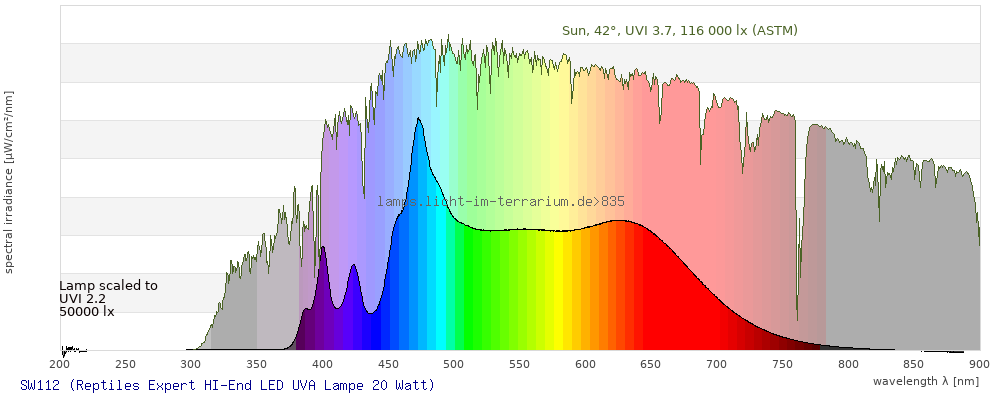
(2) Comparison of full spectrum to sunlight
The spectrum is compared to the ASTM spectrum. The measured spectrum is scaled to a lux or UVI value that seems to "make sense" to the database. This can go wrong, depending on the quality and range of the data.
(3) Colorimetry
Colorimetry is the science to describe physically the human color perception. The wavelength range 380 nm - 780 nm is visible to humans and detected by three different photoreceptors. Many Reptiles see the range 350 nm - 800 nm and have an additional UV photoreceptor in their retina.
Whereas a spectrometer measures the intensity in every tiny wavelength interval resulting in thousands of individual intensities, the human eye only measures three intensities detected by the three cones. The same is true for the reptile eye with usually three or four photoreceptors. Effectively the detailled spectrum displayed above reduces to a much compacter bar graph displayed below. The photoreceptor sensitivites from these L-Cone, M-Cone, S-Cone, and U-Cone are used, they are chosen as an average of measured reptile photoreceptor sensitivity curves. The bar graph also shows as reference the intensity seen by the three or four photoreceptors for average sunlight (ASTM spectrum).
From these three numbers the colour coordinate and the correlated colour temperature for humans are calculated using the CIE standard method. I adapted this concept to a "3 cone reptile (M,S,U)" and a "4 cone reptile (L,M,S,U)". I am sure, that this adaption to other colour spaces makes sense mathematically and this is also done in scientific research regarding colour vision of animals, however I have not seen calculation of colour temperatures for other animals in the scientific literature. Even if it is hypothetical, at least this shows, how arbitrary the colour temperature is, and that the colour temperature calculated for humans does not apply to reptiles. The colour spaces also show the colour coordinates of different phases of daylight ((ids 1, 338 – 451, 511 – 513 ), indicated by crosses, coloured in the appriximate colour perceived by a human.
| Human (CIE) | 3 cone reptile | 4 cone reptile | |
|---|---|---|---|
| Cone Excitation | |||
| Colour Coordinate | ( 0.33 ; 0.35 ) | ( 0.54 ; 0.33 ) | ( 0.32 ; 0.37 ; 0.23 ) |
| CCT | 5400 Kelvin | 3300 Kelvin | 4500 Kelvin |
| distance | 0.021 | 0.082 | |
| colour space | 3-D-graph not implemented yet |
(4) Vitamin D3 Analysis
Vitamin D3 is produced by UVB radiation around 300 nm. 7DHC/ProD3 present in the skin is converted to PreD3 when absorbing an UV photon. PreD3 can be converted back to ProD3, to Lumisterol, or to Tachysterol when absorbing another UV photon or can be converted to Vitamin D3 in a warm environment.

This process prevents any overdose of vitamin D3 from UV radiation with a spectrum similar to sunlight. As a comparison the solar spectra at 20°(id:14) and at 85°(id:21) solar angle are shown.
The ratio of the readings of two solarmeters 6.2 (UVB) and 6.5 (UV index) has proven a useful and very simply number to acess the spectral shape in the vitamin-d3-active region.
(5) Effective Irradiances
Effective irradiances are calculated for all ranges, actionspectra and radiometers currently present in this database.
The calculation method is a numerical implementation (Simpson's rule) of the formula
To learn more about calculating effective irradiances and radiometers I recommend this excellent report on UVB meters: Characterizing the Performance of Integral Measuring UV-Meters (pdf).
The numbers in the following tables can also be used to estimate certain (effective) irradiances from radiomer readings. Example: If the database lists
- range: UVB (US) = 13.8 µW/cm²
- radiometer: Solarmeter 6.2 = 19.6 µW/cm²
(5a) Ranges
total ( 0 nm - 0 nm) 20800 µW/cm² = 208 W/m² UVC ( 0 nm - 280 nm) -0.362 µW/cm² = -0.00362 W/m² non-terrestrial ( 0 nm - 290 nm) 1.27 µW/cm² = 0.0127 W/m² total2 ( 250 nm - 880 nm) 20900 µW/cm² = 209 W/m² UVB (EU) ( 280 nm - 315 nm) 10.1 µW/cm² = 0.101 W/m² UVB (US) ( 280 nm - 320 nm) 12.5 µW/cm² = 0.125 W/m² UVA+B ( 280 nm - 380 nm) 68.5 µW/cm² = 0.685 W/m² Solar UVB ( 290 nm - 315 nm) 8.47 µW/cm² = 0.0847 W/m² UVA D3 regulating ( 315 nm - 335 nm) 8.64 µW/cm² = 0.0864 W/m² UVA (EU) ( 315 nm - 380 nm) 58.4 µW/cm² = 0.584 W/m² UVA2 (medical definition) ( 320 nm - 340 nm) 8.1 µW/cm² = 0.081 W/m² UVA (US) ( 320 nm - 380 nm) 56 µW/cm² = 0.56 W/m² UVA1 (variant) ( 335 nm - 380 nm) 49.8 µW/cm² = 0.498 W/m² UVA1 (medical) ( 340 nm - 400 nm) 632 µW/cm² = 6.32 W/m² vis. UVA ( 350 nm - 380 nm) 44.2 µW/cm² = 0.442 W/m² VIS Rep3 ( 350 nm - 600 nm) 13800 µW/cm² = 138 W/m² VIS Rep4 ( 350 nm - 700 nm) 19800 µW/cm² = 198 W/m² purple ( 380 nm - 420 nm) 1260 µW/cm² = 12.6 W/m² VIS ( 380 nm - 780 nm) 20700 µW/cm² = 207 W/m² VIS2 ( 400 nm - 680 nm) 18400 µW/cm² = 184 W/m² PAR ( 400 nm - 700 nm) 19200 µW/cm² = 192 W/m² blue ( 420 nm - 490 nm) 4880 µW/cm² = 48.8 W/m² green ( 490 nm - 575 nm) 5940 µW/cm² = 59.4 W/m² yellow ( 575 nm - 585 nm) 685 µW/cm² = 6.85 W/m² orange ( 585 nm - 650 nm) 4580 µW/cm² = 45.8 W/m² tmp ( 600 nm - 1000 nm) 7000 µW/cm² = 70 W/m² red ( 650 nm - 780 nm) 3380 µW/cm² = 33.8 W/m² IR2 ( 655 nm - 685 nm) 1580 µW/cm² = 15.8 W/m² IRA ( 700 nm - 1400 nm) 1020 µW/cm² = 10.2 W/m² IRB ( 1400 nm - 3000 nm) 0 µW/cm² = 0 W/m²
(5b) Actionspectra
Erythema 2.36 UV-Index Pyrimidine dimerization of DNA 5.5 µW/cm² Photoceratitis 3.61 µW/cm² Photoconjunctivitis 0.731 µW/cm² DNA Damage 1.57 Vitamin D3 6.14 µW/cm² Photosynthesis 13400 µW/cm² Luminosity 54000 lx Human L-Cone 8070 µW/cm² Human M-Cone 6700 µW/cm² Human S-Cone 3480 µW/cm² CIE X 7140 µW/cm² CIE Y 7460 µW/cm² CIE Z 6750 µW/cm² PAR PPFD 902 µmol/m²/s Extinction preD3 33.1 e-3*m²/mol Extinction Tachysterol 121 e-3*m²/mol Exctincition PreD3 21700 m²/mol Extinction Lumisterol 25.3 m²/mol Exctincition Tachysterol 157000 m²/mol Extinction 7DHC 33 m²/mol L-Cone 6890 µW/cm² M-Cone 8010 µW/cm² S-Cone 4980 µW/cm² U-Cone 1940 µW/cm² UVR - ICNIRP 2004 3.63 Rel Biol Eff Melatonin Supression 5960 µW/cm² Blue Light Hazard 3890 µW/cm² (72.1 µW/cm² per 1000 lx) CIE 174:2006 PreVit D3 6.37 µW/cm² Lumen Reptil 53200 "pseudo-lx" Vitamin D3 Degradation 4.29 µW/cm² Actinic UV 3.61 µW/cm² (0.668 mW/klm) Exctincition Lumisterol 29500 m²/mol Exctincition 7DHC 37800 m²/mol Exctincition Toxisterols 594 m²/mol UV-Index2 1.82 UV-Index (285-400nm)
(5c) Broadbandmeters
Solarmeter 6.2 (UVB, pre 2010) 18.9 µW/cm² Solarmeter 6.5 (UV-Index, pre 2010) 2.11 Leybold UVB 9.75 µW/cm² Leybold UVA 95.1 µW/cm² Leybold UVC 0.0538 µW/cm² DeltaOhm UVB 15.9 µW/cm² DeltaOhm UVC 2.97 µW/cm² Vernier UVB 6.02 µW/cm² Vernier UVA 29.1 µW/cm² Gröbel UVA 53.4 µW/cm² Gröbel UVB 8.64 µW/cm² Gröbel UVC 0.302 µW/cm² Luxmeter 54300 lx Solarmeter 6.4 (D3) 6.58 IU/min UVX-31 17.3 µW/cm² IL UVB 0.0076 µW/cm² IL UVA 91.1 µW/cm² Solarmeter 6.5 (UVI, post 2010) 1.26 UV-Index Solarmeter 6.2 (UVB, post 2010) 8.21 µW/cm² (Solarmeter Ratio = 6.54) Solarmeter AlGaN 6.5 UVI sensor 9.33 UV Index GenUV 7.1 UV-Index 0.59 UV-Index Solarmeter 10.0 (Global Power) (manuf.) 224 W/m² Solarmeter 4.0 (UVA) 5.2 mW/cm² LS122 (manuf.) -0.0619 W/m² ISM400 (first guess) 164 W/m² LS122 (assumption) 8.06 W/m² ISM400_new 136 W/m² Solarmeter 10.0 (Global Power) (assumption) 218 W/m²
(5d) Summary of my favourites
| UVC (0nm -280nm) [µW/cm] | -0.362 | -0.00174 % |
| non-terrestrial (0nm -290nm) [µW/cm] | 1.27 | 0.00607 % |
| UVB (EU) (280nm -315nm) [µW/cm] | 10.1 | 0.0484 % |
| UVB (US) (280nm -320nm) [µW/cm] | 12.5 | 0.0598 % |
| Solar UVB (290nm -315nm) [µW/cm] | 8.47 | 0.0406 % |
| UVA (EU) (315nm -380nm) [µW/cm] | 58.4 | 0.28 % |
| UVA (US) (320nm -380nm) [µW/cm] | 56 | 0.269 % |
| UVA2 (medical definition) (320nm -340nm) [µW/cm] | 8.1 | 0.0388 % |
| UVA1 (medical) (340nm -400nm) [µW/cm] | 632 | 3.03 % |
| UVA D3 regulating (315nm -335nm) [µW/cm] | 8.64 | 0.0414 % |
| vis. UVA (350nm -380nm) [µW/cm] | 44.2 | 0.212 % |
| VIS (380nm -780nm) [µW/cm] | 20700 | 99.4 % |
| blue (420nm -490nm) [µW/cm] | 4880 | 23.4 % |
| total2 (250nm -880nm) [µW/cm] | 20900 | 100 % |
| UV-Index2 [UV-Index] | 1.82 | |
| Luminosity [lx] | 54000 | |
| Blue Light Hazard [µW/cm²] | 3890 | 72.1µW/cm/1000lx |
| Solarmeter 6.5 (UVI, post 2010) [UV-Index] | 1.26 | |
| Solarmeter 6.2 (UVB, post 2010) [µW/cm²] | 8.21 | |
| Actinic UV [µW/cm²] | 3.61 | 15 at UVI7.6 |
| Vitamin D3 [µW/cm²] | 6.14 | 25.6 at UVI7.6 |